
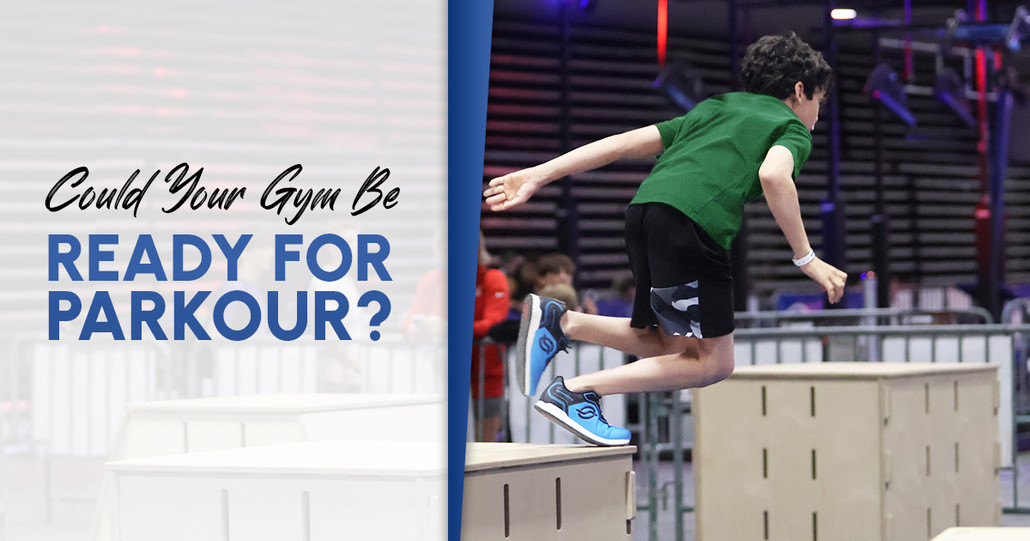
Could Parkour Be the Next Addition to Your Gym?
Posted by DGS on Aug 21st 2026
Parkour may look like a completely different world from gymnastics, but gymnastics clubs may already have much of what they need to get started.
With World Gymnastics (FIG) hosting Parkour World Championships and World Cups, and USA Gymnastics building out its own parkour programs and competition pathway, parkour is becoming an increasingly established sport.
For gymnastics clubs, that creates an opportunity to expand programming without starting completely from scratch.
YOU ALREADY HAVE THE FOUNDATION
Your Coaches Already Teach Movement
At its core, parkour is about learning to move through an environment with control, efficiency, and creativity. Sound familiar?
Gymnastics coaches already teach athletes how to control their bodies, understand spatial awareness, develop strength, stick landings, and progress safely through increasingly difficult skills. Those same fundamentals carry over into parkour.
The difference is how athletes apply them.
Parkour adds skills like vaults, precision jumps, wall runs, bar work, drops, and flips, then challenges athletes to connect those movements into their own lines.
Your coaches already have the experience of breaking skills down, teaching progressions, and helping athletes build confidence. Parkour gives them another way to put those skills to work.
You May Already Have the Equipment, Too
You don't necessarily need to build an entirely new facility to introduce parkour.
Many gyms already have open space and equipment that can be repurposed for parkour. Platforms, blocks, panel mats, springboards, bars, and other familiar pieces can become part of new movement paths and challenges. Add a few versatile parkour pieces, and you can create new combinations, challenges, and movement paths without dedicating an entire room to the sport.
And you don't have to do everything at once. Start with a few pieces, introduce parkour programming, see how your athletes respond, and expand your setup as the program grows.
SAFETY COMES FIRST
We know one of the first questions you're likely to have is about safety.
Parkour can look intimidating from the outside. But just like gymnastics, safe training comes down to appropriate progressions, proper equipment, controlled environments, and knowledgeable coaching.
Your coaches are already doing much of this work every day.
They know how to evaluate an athlete's ability, introduce new skills progressively, teach proper landing mechanics, and recognize when an athlete is ready to move on to the next challenge.
Parkour coaching follows many of those same principles.
Training Is Available
Coaches don't have to figure out parkour on their own, either. Training and certification opportunities are available for coaches who want to develop their parkour knowledge and learn how to safely introduce the sport in their gym.
That means your existing coaching experience can provide the foundation, while additional parkour-specific education can help your staff build the skills and confidence to take the next step.
The goal isn't to make parkour as risky as possible. It's to teach athletes how to move through their environment with control.
BRING SOMETHING NEW TO THE GYM
So if parkour shares so much with gymnastics, what makes it worth adding?
The movement and the environment.
Parkour vs. Gymnastics
Gymnastics and parkour share a lot of the same movement fundamentals, but they use them in very different environments.
Gymnastics typically teaches athletes to perform skills on dedicated apparatus and defined surfaces. Parkour takes those same fundamentals and puts them into a three-dimensional environment, where athletes move over, under, around, and through obstacles.
And one of the biggest connections between the two? Parkour is also about flipping.
Front flips, back flips, twisting, and other aerial skills can be incorporated into parkour lines and used to move through an environment in creative ways. For gymnasts, this creates an opportunity to take skills they already know and apply them in a completely different setting.
A vault can lead into a flip. A wall can become part of a takeoff. A drop can become an aerial skill. Instead of performing skills on a single piece of apparatus, athletes learn to connect them into a continuous line.
It's familiar movement with a whole new environment to explore.
Parkour vs. Ninja
If your gym already offers Ninja, parkour can complement what you are already doing rather than compete with it.
Ninja tends to be heavily focused on obstacle completion, grip strength, and upper-body endurance. Parkour places more emphasis on movement, speed, vaults, jumps, flips, and connecting skills through an environment. Ninja is not about flipping. Parkour is.
There is plenty of crossover, but the experience is different. That difference can be an advantage. Athletes who enjoy Ninja may discover a new challenge in parkour. In Ninja, the obstacle is typically the challenge to overcome. In parkour, the environment becomes part of the movement, with athletes using obstacles as takeoffs, landings, transitions, and platforms for aerial skills.
A NATURAL NEXT STEP
Adding parkour doesn't mean turning your gymnastics facility into a parkour gym overnight. You may already have equipment that can help create a training environment. You already have coaches who understand movement and know how to teach athletes progressively and safely.
Parkour simply gives you another way to use those strengths. Whether you start with a weekly class, add parkour to camps and clinics, or eventually develop a competitive program, you can build it at a pace that makes sense for your gym.
Start with what you have. Add what you need. Build from there.
Explore our parkour equipment to see what you can add to your gym.